

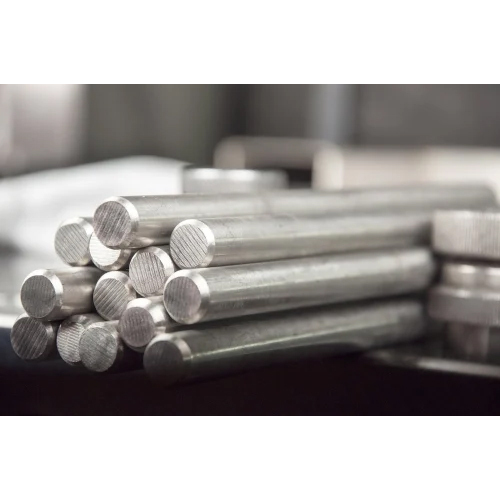
Stainless Steel Round Bars
220 INR/Kilograms
Product Details:
- Heat Resistance Yes
- Hardness 160-250 HB (varies by grade)
- Diameter 6 mm to 300 mm (custom sizes available)
- Corrosion Resistant Yes, excellent corrosion resistance
- Product Form Solid Bar
- Recyclable Yes, 100%
- Size Customizable, available in standard and cut-to-size
- Click to view more
X
Stainless Steel Round Bars Price And Quantity
- 25 Kilograms
- 220 INR/Kilograms
Stainless Steel Round Bars Product Specifications
- Yes, 100%
- Customizable, available in standard and cut-to-size
- N/A (specify as per diameter)
- None (self-finished, passivated if specified)
- Cr: 18-20%, Ni: 8-12% (for 304), varies by grade
- SS304, SS316, SS410, SS420, SS431, SS202, etc.
- Industrial
- Iron, Chromium, Nickel, possible Manganese, Molybdenum depending on grade
- Varies as per length and diameter, standard weights from 1 kg to 500 kg per bar
- Stainless Steel
- 520 - 800 MPa (depending on grade)
- Silver
- ASTM A276, A484, A479, EN-10088-3
- Bright, Polished, Peeled, Black, Annealed
- Round
- Yes
- 160-250 HB (varies by grade)
- Bright, Polished, Matte, Annealed
- Construction
- Customizable, standard lengths available up to 6 meters
- 6 mm to 300 mm (custom sizes available)
- Yes, excellent corrosion resistance
- General Engineering, Shafts, Fasteners, Fittings, Valves, Marine Applications
- Stainless Steel Round Bars
- Solid Bar
- Round Bar
- Sheared, Saw Cut, Machined
- Min 35% (for austenitic grades)
- 3.2 Ra m (as specified)
- Standard export worthy packing; bundle with plastic/steel straps or as required
- 7-20 days depending on order size and customization
- H9, H10, or as per client requirement
- Excellent (for 304/316), varies with grade
- Good (improves after annealing depending on grade)
- Non-magnetic (Austenitic grades), Magnetic (Martensitic/Ferritic grades)
- Hot Rolled & Cold Drawn options available
- 7.85 g/cm3
- As per supplier policy, usually starts from 100 kg
- Store in dry, covered area to prevent surface contamination
Stainless Steel Round Bars Trade Information
- 100 Kilograms Per Day
- 7 Days
Product Description
| Application | Construction |
| Material Grade | SS201, SS202, SS303, SS304, SS304L, SS310S, SS316, SS316L |
| Single Piece Length | 1 to 6 m |
| Size | 3 to 100mm (1/8 to 4 inch) |
| Material | Stainless Steel |
| Tolerance | H8, H9 , H10, H11, A484, DIN 1013 |
Customizable Stainless Steel Round Bars
Our stainless steel round bars are available in a range of grades including SS304, SS316, and SS410, and can be tailored in diameter and length as per client requirements. Choose from a variety of surface finishes-bright, polished, black, or annealed-for your specific applications. With adherence to international standards and robust packaging, these round bars are engineered for durability and precision.
Advanced Manufacturing & Quality Assurance
Produced using hot rolled or cold drawn processes depending on the targeted application, these round bars undergo strict tolerance checks (H9, H10), and can be supplied with sheared, saw cut, or machined ends. With densities at 7.85 g/cm3 and tensile strengths ranging between 520-800 MPa, our bars are suitable for critical engineering and industrial uses.
Reliable Performance in Diverse Applications
Designed for sectors such as construction, marine, shafting, fasteners, and valves, our stainless steel round bars provide excellent corrosion and heat resistance (up to 870C for some grades). They offer good machinability, improved post-annealing, and are renowned for their weldability, especially in grades 304 and 316. All products are export-packed and delivered swiftly within 7-20 days.
FAQ's of Stainless Steel Round Bars:
Q: How are stainless steel round bars manufactured and what processes are available?
A: Stainless steel round bars are produced primarily through hot rolling or cold drawing. Hot rolling shapes the bars at high temperatures for enhanced strength and larger sizes, while cold drawing improves surface finish, dimensional accuracy, and mechanical properties. Both processes are selected based on your specific application or material grade needs.Q: What is the minimum order quantity for these round bars and do sizes vary?
A: The minimum order quantity typically starts from 100 kg, but it may vary based on the supplier's policy. Diameters are customizable from 6 mm to 300 mm, with standard and cut-to-size lengths available, ensuring suitability for both bulk industrial and specialized requirements.Q: When should I choose austenitic, ferritic, or martensitic grades for my application?
A: Austenitic grades (like SS304, SS316) are non-magnetic, corrosion-resistant, and suitable for marine and hygienic environments. Ferritic and martensitic grades offer magnetic properties and increased hardness, making them ideal for engineering components where wear or magnetism is necessary.Q: Where should stainless steel round bars be stored to maintain quality?
A: For optimum preservation, store the round bars in dry, covered areas to shield them from moisture or contaminants. Adequate storage minimizes the risk of surface corrosion and maintains the product's integrity prior to machining or installation.Q: What are the end condition and finishing options for stainless steel round bars?
A: End conditions available include sheared, saw cut, and machined ends. Surface finishes range from bright and polished to black or annealed, and tolerances such as H9 or H10 can be specified. These options allow you to match the product to exact project specifications and performance requirements.Q: How does annealing affect the machinability of stainless steel round bars?
A: Annealing improves the machinability of most stainless steel grades by reducing hardness and enhancing ductility. This process is especially beneficial when subsequent machining operations or complex fabrications are required.Q: What are the main benefits of using stainless steel round bars in industrial applications?
A: Stainless steel round bars provide superior corrosion and heat resistance, high tensile strength, and excellent weldability. Their recyclability, customizable dimensions, and variety of finishes ensure versatility, durability, and environmental sustainability across a wide array of engineering and construction tasks.Tell us about your requirement

Price:
Quantity
Select Unit
- 50
- 100
- 200
- 250
- 500
- 1000+
Additional detail
Mobile number
Email

Other Products in 'Stainless Steel Bars' category


|


Contact Details

- 104, Shreepati Castle, 1st Floor, C Wing, Khetwadi Main Road,Mumbai - 400004, Maharashtra, India
- Phone : 08045478301
GST : 27AKQPS4929J1ZB

- Mr Rajesh K Shah (Proprietor)
- Mobile : 08045478301
- Send Inquiry
 Send Inquiry
 Send Inquiry
 Send SMS
 Call Me Free

ARIHANT METAL
All Rights Reserved.(Terms of Use)
Developed and Managed by Infocom Network Private Limited.
Developed and Managed by Infocom Network Private Limited.


 English
 Spanish
 French
 German
 Italian
 Chinese (Simplified)
 Japanese
 Korean
 Arabic
 Portuguese