

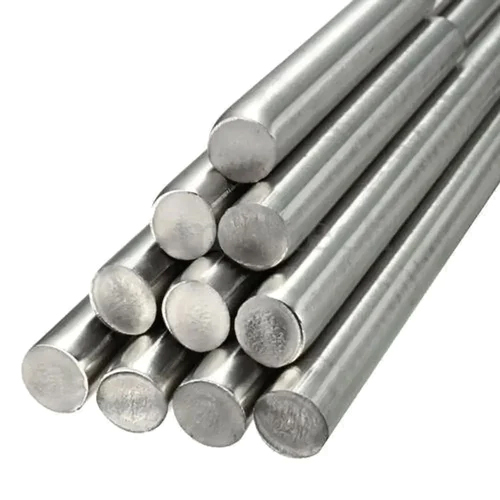
Stainless Steel Bars
170 INR/Kilograms
Product Details:
- Heat Resistance Yes
- Tensile Strength 520 - 860 MPa (depends on grade)
- Product Form Solid Bar
- Corrosion Resistant Yes
- Recyclable Yes
- Material Composition % Cr 16-18%, Ni 8-10% (for 304), other elements as per grade
- Hardness HRB 70 - 90 (varies by grade)
- Click to view more
X
Stainless Steel Bars Price And Quantity
- 25 Kilograms
- 170 INR/Kilograms
Stainless Steel Bars Product Specifications
- Length up to 6 meters or as per customer requirement
- Silver
- Stainless Steel
- 6 mm to 150 mm
- Stainless Steel Products
- Structural support, Shafts, Fasteners, Frameworks, Machined parts
- 5 mm to 100 mm
- HRB 70 - 90 (varies by grade)
- Bright, Polished, Black
- Iron, Chromium, Nickel (varies by grade)
- Polished, Bright, Black, Pickled
- Depends on size and length
- Uncoated / Passivated
- 304, 316, 202, 410, etc.
- Yes
- Solid Bar
- Bar
- Round, Square, Flat, Hexagonal
- ASTM A276, A484, A582, A564
- Yes
- Cr 16-18%, Ni 8-10% (for 304), other elements as per grade
- 520 - 860 MPa (depends on grade)
- Yes
- Customizable as per requirement
- Construction, Machine Manufacturing, Industrial, Structural, Marine, Automobile, Fabrication
- Industrial
- Yes
- Ready Stock / As per order quantity
- 210 MPa (for 304 grade)
- Hot Rolled / Cold Drawn
- Bundle, Wooden Box, Custom Packaging
- Non-magnetic (for austenitic grades), Magnetic (for martensitic grades)
- As per supplier
- Good, depends on grade
- 40% (for typical 304 grade)
- 7.85 g/cm3
- Plain, Chamfered, as required
Stainless Steel Bars Trade Information
- 100 Kilograms Per Day
- 7 Days
Product Description
| Shape | Round, Square, Hexagonal etc |
| Usage/Application | Industrial |
| Size | 1-10 mm |
| Brand | viraj, bansal, rimjim |
| Material | Stainless Steel |
| Material Grade | SS201, SS202, SS303, SS304, SS304L, SS310S, SS316, SS316L, SS410, SS416, SS420 etc |
| Application | Construction |
| Single Piece Length | 1 to 6 m |
| Technique | Hot Rolled |
| Corrosion Resistant | Yes |
Superior Manufacturing for Every Need
These stainless steel bars are produced using advanced hot rolled and cold drawn methods, ensuring the ideal combination of strength and surface quality. With customizable dimensions, finishes, and edge types, they cater to a wide range of industry demands. Each bar is crafted to precise standards, offering reliability in critical construction, industrial, structural, and marine environments.
Applications That Go Beyond Expectations
Due to their excellent corrosion and heat resistance, stainless steel bars are suited for harsh and demanding settings. From providing robust structural support and serving as shafts or fasteners, to their use in machine manufacturing and marine frameworks, these bars are a versatile solution trusted by engineers and fabricators alike.
FAQ's of Stainless Steel Bars:
Q: How are stainless steel bars manufactured?
A: Stainless steel bars are manufactured using hot rolling or cold drawing processes, depending on the desired finish and mechanical properties. Hot rolled bars offer enhanced ductility, while cold drawn bars provide better dimensional accuracy and surface quality. The selection of process depends on application requirements.Q: What are the standard sizes and shapes available for stainless steel bars?
A: These bars are available in various thicknesses (5 mm to 100 mm), diameters (6 mm to 150 mm), and shapes, including round, square, flat, and hexagonal. Lengths can be customized up to 6 meters or as per customer specifications, ensuring suitability for diverse project needs.Q: When should I choose austenitic or martensitic stainless steel bars?
A: Austenitic grades such as 304 and 316 are preferred for non-magnetic applications and environments requiring high corrosion and heat resistance. For projects that demand magnetic properties or greater hardness, martensitic grades like 410 are ideal.Q: Where can stainless steel bars be used effectively?
A: Stainless steel bars are used across a broad spectrum of industries, including construction, industrial machinery, structural frameworks, marine, automotive, and fabrication. Their adaptability and strength make them valuable in both structural support and as precision-machined parts.Q: What are the benefits of using stainless steel bars over other materials?
A: Stainless steel bars offer excellent corrosion resistance, high strength-to-weight ratio, recyclability, and sustained mechanical properties even at elevated temperatures (up to 870C for 304/316 grades). Their aesthetic finish and durability reduce maintenance and replacement costs over time.Q: How is the material composition and grade decided?
A: Material composition, such as chromium (16-18%) and nickel (8-10%) content for grade 304, varies by grade and is selected based on environmental exposure, required mechanical strength, and specific industry standards. Suppliers assist customers in selecting appropriate grades for their application.Tell us about your requirement

Price:
Quantity
Select Unit
- 50
- 100
- 200
- 250
- 500
- 1000+
Additional detail
Mobile number
Email

Other Products in 'Stainless Steel Bars' category



|


Contact Details

- 104, Shreepati Castle, 1st Floor, C Wing, Khetwadi Main Road,Mumbai - 400004, Maharashtra, India
- Phone : 08045478301
GST : 27AKQPS4929J1ZB

- Mr Rajesh K Shah (Proprietor)
- Mobile : 08045478301
- Send Inquiry
 Send Inquiry
 Send Inquiry
 Send SMS

ARIHANT METAL
All Rights Reserved.(Terms of Use)
Developed and Managed by Infocom Network Private Limited.
Developed and Managed by Infocom Network Private Limited.


 English
 Spanish
 French
 German
 Italian
 Chinese (Simplified)
 Japanese
 Korean
 Arabic
 Portuguese